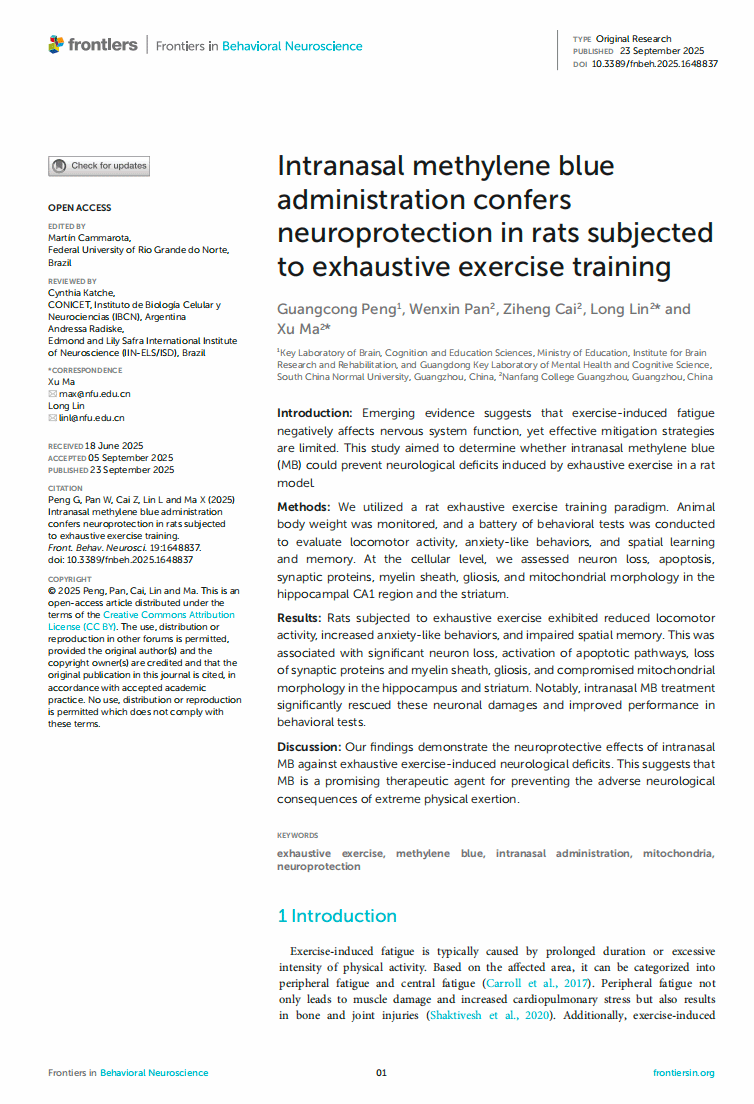
马旭老师在刊物《Frontiers in Behavioral Neuroscience》(JCR分区:Q2,IF=2.9)发表“Intranasal methylene blue administration confers neuroprotection in rats subjected to exhaustive exercise training”论文。
Abstract
Emerging evidence suggests that exercise-induced fatigue not only compromises athletic performance but also negatively affects nervous system function. However, effective strategies to prevent or mitigate its adverse neurological consequences remain limited. Using a rat exhaustive exercise training paradigm, this study aims to determine whether intranasal methylene blue (MB) can mitigate neuronal damage and prevent neurological deficits induced by exhaustive exercise. The body weight of the animals was monitored daily throughout the exhaustive exercise training session. Additionally, a battery of behavioral tests was conducted to evaluate alterations in locomotor activity, anxiety-like behaviors, and spatial learning and memory performance. The results showed that rats subjected to exhaustive exercise training exhibited reduced locomotor and exploratory activities, increased anxiety-like behaviors, and impaired spatial memory. Furthermore, exhaustive exercise training led to significant neuron loss, activation of apoptotic path-way, synaptic protein and myelin sheath loss, gliosis, and compromised mitochondrial morphology in the hippocampal CAl region and the striatum. Notably, MB treatment significantly rescued these neuronal damages, and MB-treated animals displayed improved performance in behavioral tests. Our findings support the neuroprotective effects of MB against exhaustive-induced neurological deficits and suggest that MB may serve as a promising agent for preventing the adverse neurological consequences of exhaustive exercise.